Why This Book Exists
The original Principles Stack was written for founders building software companies — businesses where the product can change overnight, the market answers in weeks, and the cost of being wrong is a sprint, not a submission. Medical technology founders live under different physics. Their product cannot change without permission. Their market does not answer until a payer decides to pay. And the cost of being wrong is measured in clinical trial years and regulatory review cycles that no amount of hustle can compress.
Yet the medtech founder is handed the software founder’s playbook anyway. The accelerators teach lean startup. The investors quote SaaS metrics. The books on the shelf assume the product ships when the founder says so. The result is predictable: brilliant clinical ideas run out of money in the valley between FDA clearance and the first reimbursement dollar — a valley the software literature does not even have a name for.
The Problem with Deploying AI First
Every week another founder tells me the same story. They read about a competitor deploying AI. They feel the urgency. They bring in a team, stand up a model, point it at some part of their business, and wait for the transformation. What they get instead is a faster version of whatever they were already doing — including their mistakes.
AI is an amplifier. That is both its extraordinary power and its most dangerous property. It amplifies what is already there: good strategy becomes better, weak fundamentals become more visibly weak, misaligned incentives scale faster, and unclear thinking produces more polished-looking wrong answers. A company with a broken pricing model that deploys AI pricing tools does not fix its pricing — it automates its pricing mistakes at speed.
This is why principles come before AI. Not as a philosophical preference. As a practical requirement. If you do not
Flagship Masterworks
The Financial and Psychological Cost of Bootstrapping vs. Raising
Two Ledgers
Every founder keeps two ledgers. The first is the one everyone expects: revenue, burn, runway, valuation. It gets audited, reported to a board, and eventually printed in a term sheet or a press release. The second ledger is never audited and rarely even written down, and it is the one this book is actually about — the accounting of what a founder spends that no financial statement captures. Time with a spouse who didn't sign up to be a co-founder. A body that stopped being asked how it was doing. A version of the company, and a version of the founder, that a different capital decision would have produced instead.
Founders are taught, almost from the first pitch meeting, to think fluently in the language of the first ledger. Nobody teaches the second. It is learned, if it is learned at all, after the fact — in the exhaustion after a raise that solved the cash problem and created three new ones, or in the quiet calculation of a bootstrapped founder wondering, a decade in, what the company might have become with outside capital and what they might have kept if it hadn't.
Technology Business Plans
This volume brings together four books that were designed to be read in sequence — or consulted independently — by anyone engaged in the entrepreneurial process. Together, they form a complete curriculum on the business plan: how to write it, how to analyze it as an investor, how to present it with conviction and skill, and how to defend it when it is challenged.
I have organized this collection to reflect the natural sequence of the entrepreneurial funding journey. You begin by writing your plan, drawing on the frameworks and examples in Book I. You then step into the shoes of the investor in Book II — a perspective shift that will transform how you think about every claim in your own plan. In Book III, you prepare to take that plan into the room and convert investor interest into investment. And in Book IV, you prepare to defend that plan under the hardest scrutiny — the due diligence, the tough questions, and the negotiation that decide whether the deal survives.
These four skills — writing, examining, pitching, and defending — are more deeply intertwined than most entrepreneurs realize. The best writers of business plans understand what investors look for because they think like investors. The best pitchers have internalized their plans so completely that they can answer any question from any angle without notes. And the best investors write business plans themselves — because building the mental model of a business from scratch is the deepest form of analysis.
A pitch is not a presentation. A presentation delivers information. A pitch changes a decision. The goal of every investor pitch is to move a specific person from skepticism to conviction — not about your idea in the abstract, but about your specific business, your specific team, and your specific ask at this specific moment. Every word, every slide, every number, and every story in your pitch should serve one purpose: moving the person across the table from 'I'm not sure' to 'I want to be involved in this.'
Medtech Technology Business Plans
A technology plan is a market argument. A medtech plan is a permissions-and-payment argument. The skeleton is shared; the load-bearing walls move.
WHAT THE ROOM IS LISTENING FOR
Every experienced medtech audience runs the four-stop read on your voice: pathway, payment, runway, team. Your pitch either feeds those stops in order or leaves the room to run them as objections.
Business Plan Mastery Collections
The Plan as a Thinking Tool
In an era of pitch decks and one-pagers, the business plan remains the single most complete test of whether a founder truly understands their own business. Writing one forces clarity that no other exercise produces. Every assumption must be stated explicitly. Every gap in knowledge becomes visible on the page. Investors who receive a well-written plan know immediately that the founder has done the thinking — not just the hoping. The plan disciplines the mind before it disciplines the market.
Internal vs. External Purpose
Most founders make a critical mistake: they write the plan for investors and forget to write it for themselves. A plan written purely to attract funding is a marketing document. A plan written as a genuine thinking tool becomes the operating manual for the business. The best plans serve both purposes simultaneously — but only when the internal purpose comes first. If you cannot convince yourself on paper, you will not convince an investor in person.
This is the fourth book in a sequence. If you have read the first three — on writing, examining, and pitching a business plan — this one completes the arc: what to do when the plan you built, inspected, and presented is finally attacked.
The book is built in three parts. Part I is the craft of defense itself — the mindset, red-teaming your own plan, and reading a hard question. Part II walks the five places every plan is attacked: the market, the model, the financials, the team, and the moat. Part III is defense under live fire — when to concede, when to hold, and how to carry yourself in the room.
THE DIFFERENT DOCUMENT
A technology plan is a market argument. A medtech plan is a permissions-and-payment argument. The skeleton is shared; the load-bearing walls move.
WHAT DEFENSE ACTUALLY IS
The defended plan is not the plan argued hardest; it is the plan whose every claim has a document behind it and a founder who knows the filing path. Defense is evidence retrieval under time pressure.
Reading vs. Examining
Examining a business plan is not the same as reading a business plan. Reading is passive. Examining is active interrogation of every claim, every assumption, and every omission. The examiner's role is to find the gap between what the plan claims and what the evidence supports — and to assess whether that gap is fatal or fixable. This requires a specific mental discipline: engage with the plan as written, but evaluate it against the world as it actually is.
Calibrated Skepticism
The most important skill an examiner develops is calibrated skepticism — the ability to apply appropriate doubt to each claim without becoming cynical. Cynicism dismisses everything. Calibrated skepticism evaluates each claim against the evidence provided and asks: is this believable given what I know about this market, this team, and this stage? Founders are optimists by construction. The examiner's job is to apply the realism the founder cannot apply to their own work.
A tech plan asks you to underwrite adoption. A medtech plan asks you to underwrite three sequential permissions — agency, payer, market — and most examiners trained on software price only the third.
The Underwriting Object
The asset you are examining is a claim about sequence: that this team, on this capital, will win the agency’s yes, then the payer’s yes, and still have runway when the market’s yes begins to compound. Every diligence hour should trace that sequence. Proteus raised half a billion dollars from examiners who priced the science and the market and never underwrote the middle permission; the assets sold for one percent of peak.

The Founder’s Omnibus gathers all twelve casebooks of the Founder’s Casebook Series in a single digital volume of more than 800 pages, with one combined table of contents so you can go straight to any part, book or case.
It is organized in three parts, each a bundle of four books: Capital & Survival, Growth & Distribution, and People & Resilience. Together they hold more than 150 case studies and the operating frameworks that come out of them, from unit economics and down rounds to distribution, regulation, AI, talent, burnout and global expansion.

Four casebooks on the human side of building a company across borders.
Overview
Companies are made of people, and founders are people too. The People & Resilience Bundle brings together four casebooks on taking a company into new markets, keeping yourself intact while you build, making the hiring, firing and equity decisions that define a team, and going global without losing the identity that made the company worth exporting.
The cases span the United States, China, Japan, Korea, India and Europe, with particular attention to what Asian markets teach Western founders.
What’s inside
· Asia or Bust: The Founder’s Guide to Market Entry & Localization — thirteen cases from America and Asia on why companies win and lose when they cross a border.
· The Founder Burnout Playbook — building companies without burning the builder: thirteen cases on pace, culture and founder sustainability.
· Talent Strategy — hiring, firing and equity decisions that make or break startups, in twelve cases.
· Global Without Losing Home — how founders conquer the world without losing themselves: adapt the surface, protect the core.
Strip away the story and the deck, and every business reduces to a single repeated transaction. Companies that ignored the unit grew and died; the ones that mastered it built fortresses.
Almost no great company is doing what it set out to do. Slack was a video game. Instagram was a check-in app. YouTube was a dating site. Twitter was a podcasting startup. The pivot is not a sign of failure — it is, for most companies, the single decision that made them.
There is a myth that great companies spring fully formed from a founder’s original vision, executed with relentless focus. The reality is messier and more hopeful: most enduring companies are the survivors of a pivot — a deliberate change in product, model, market, or technology when the original idea failed to work. The founders who won were not the ones who never changed course; they were the ones who changed course well, at the right moment, in the right direction, and with the nerve to leave the old thing behind.
Billund · Stockholm · Kyoto · Shanghai · Ventura
You can win the world and lose yourself, or lose the very
home that made you worth exporting. The masters adapt the
surface and protect the core — and knowing which is which
is the whole art.
The companies span triumphs and cautionary tales deliberately — giants expelled from foreign markets for refusing to adapt, and a Danish toymaker that nearly died wandering from its core and saved itself by coming home. The contrasts are where the lessons live, because going global without losing home is learned best by watching companies adapt brilliantly, fail to adapt fatally, and — hardest of all — scale globally while keeping their soul.
Read it cover to cover or jump to the decision you are facing — whether to enter a market, how much to localize, or how to protect your identity as you scale. Part V is the operating system: the frameworks that turn thirteen stories into a playbook. And as the capstone of the Founder’s Casebook Series, this book is where the whole journey — from regulation to talent to unit economics to pivots — comes to rest.
Capital efficiency is the most durable competitive advantage available to an early-stage company. It is also the least glamorous. The startup world celebrates the $100 million funding round, the unicorn valuation, the hockey-stick growth chart. It does not celebrate the founder who built a $500 million business by spending $40 million to get there—even though that founder has achieved something demonstrably harder and arguably more impressive.
This book is about that founder. Thirteen of them, in fact—ranging from a bootstrapped software company in rural India that became a multi-billion-dollar enterprise to a Korean e-commerce platform that endured a decade of losses to build infrastructure that its competitors could not replicate. What they share is not a funding philosophy. It is an operating philosophy: the belief that capital is a tool, not a strategy, and that the discipline required to deploy it efficiently is the same discipline required to build a company that can survive the next funding winter.
Every case in this book is drawn from public record—financial filings, founder interviews, investor memos, investigative journalism, and the emerging body of academic research on startup capital efficiency. The metrics are real. The patterns are structural.
Who This Is For: Founders at any stage who want to extend runway, reduce dilution, and build companies that survive funding cycles. Investors evaluating capital efficiency as a signal of founder quality. CFOs and operators building financial discipline into growth-stage companies. Anyone who has ever looked at a burn rate and wondered whether there was a better way.
The Fear Series is a collection of twelve practitioner casebooks, each examining one of the twelve fears that most commonly prevent technology entrepreneurs from making the decisions that would save their companies.
The series is built on a single premise: the fear is not the most dangerous thing. The decision the fear prevents is. The companies in these casebooks did not succeed because their founders felt less fear than others. They succeeded because they made better decisions despite feeling the same fear.
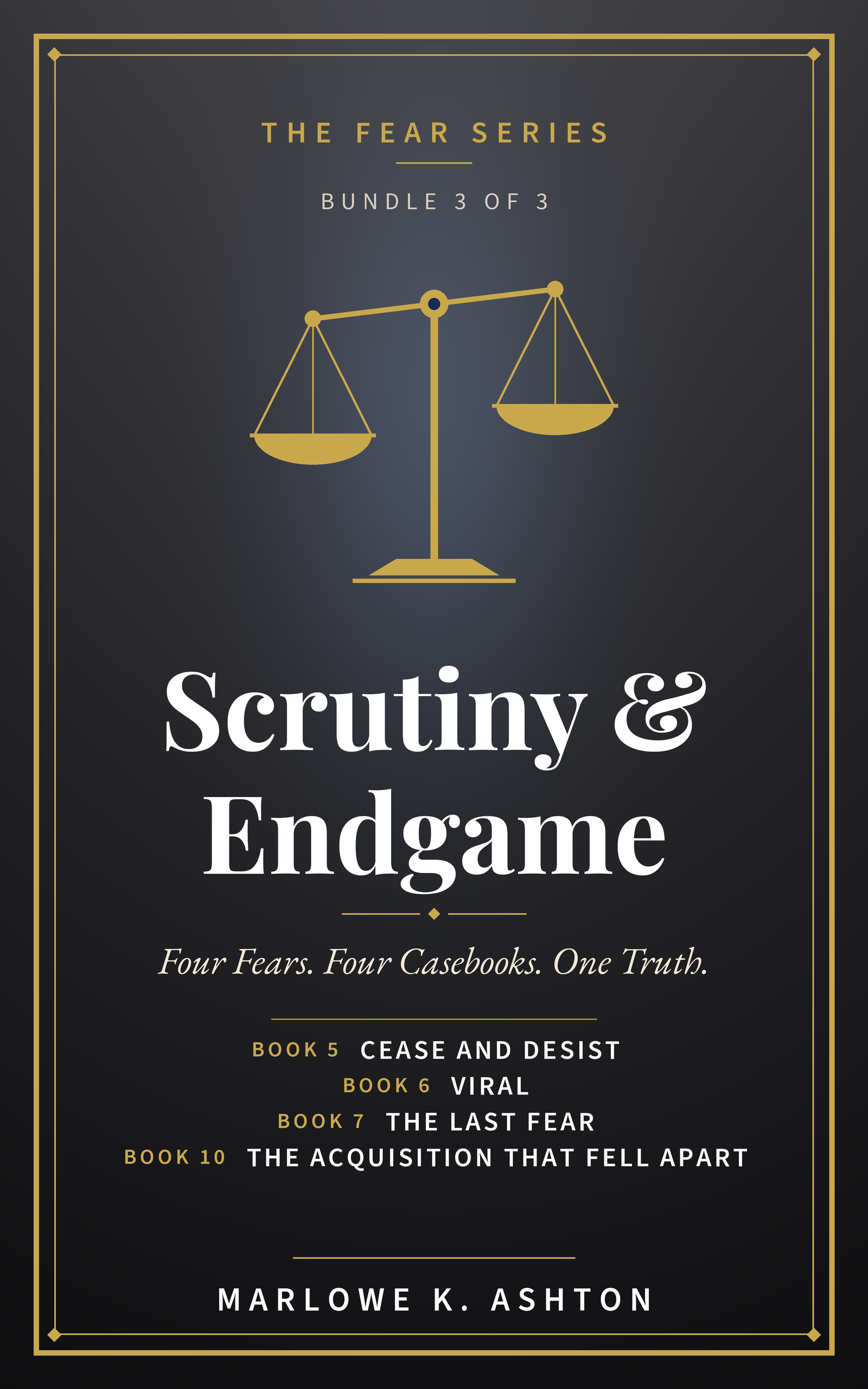
This bundle gathers four of the twelve practitioner casebooks in The Fear Series, each examining one of the fears that most commonly prevent technology entrepreneurs from making the decisions that would save their companies. The four collected here concern the moments played out under outside scrutiny: regulators, public opinion, public failure, and the deal that collapses.
The series is built on a single premise: the fear is not the most dangerous thing. The decision the fear prevents is. The companies in these casebooks did not succeed because their founders felt less fear than others. They succeeded because they made better decisions despite feeling the same fear.
Cease and Desist - Regulatory shutdown
Viral - Reputational damage
The Last Fear - Public failure itself
The Acquisition That Fell Apart - A deal collapsing
Introduction: The Giant in the Room
Every technology entrepreneur eventually faces the same conversation with an investor, a board member, or a sleepless 3am internal monologue: "But what happens when Google builds this?" Or Microsoft. Or Amazon. Or a well-funded competitor that raised $200M last month while you are still closing your seed.
The fear is rational. Resources matter. Distribution matters. Brand matters. A company with ten times your capital can out-market you, out-hire you, out-develop you, and — if they choose — price below cost until you cannot serve customers profitably.
And yet. The graveyard of technology is not filled with well-funded underdogs who were crushed by giants. It is filled with giants who failed to move fast enough, who could not focus, whose size became their prison. The companies in this casebook were outgunned. None of them lost.
Every company that grows fast eventually discovers the same uncomfortable reality: the larger your platform, the more visible your mistakes. The product failure that would have been an internal postmortem at a ten-person startup becomes a press story at a hundred-person company and a congressional hearing at a thousand-person company.
Reputational damage is not the same as bad press. Bad press is noise. Reputational damage is signal — it tells customers, investors, employees, and regulators something specific about the company that changes their behavior. The fear of reputational damage is, in part, a fear of losing narrative control. The story that defines your company is the story your customers and competitors will tell when you are not in the room.
This casebook documents seven technology companies that experienced significant reputational crises — and the strategies, decisions, and leaders that determined whether those crises ended the company or strengthened it.
The Fear No One Names
Every founder is prepared, at least in the abstract, to fear running out of money. They expect to fear a faster-moving competitor, a regulator, a bad month of churn. What almost no one prepares for is the fear that the person who started the company beside them will not be there to finish it — and that when the split comes, it will not look like a business decision. It will look like a divorce, because in every way that matters, it is one.
This fear hides for a simple reason: naming it feels like betrayal before anything has gone wrong. To ask “what happens if my co-founder and I don't make it” while the partnership is working is treated, culturally, as an act of disloyalty — the startup equivalent of a prenup conversation on the way to the altar. So founders skip it. They sign standard paperwork drafted for the good scenario, and they carry no plan at all for the other one.
Why This Fear Is Different From the Others
The other fears in this series — running out of money, losing to a competitor, regulatory shutdown — are adversarial. There is a clear outside force and a clear defense. The co-founder divorce is different because the threat and the asset are the same person. The relationship that built the company is also the relationship that can unbuild it, and there is no outside party to blame, no market condition to point to, and often no clean moment when everyone agrees the marriage is over.
This is also the fear most likely to be denied even as it is happening. Founders describe drifting apart for a year or more before either party says so out loud. By the time it surfaces — often at the worst possible moment, mid-raise or mid-crisis — the emotional and financial cost has already compounded well past what an early, honest conversation would have cost.
Every fraud in this book exploited the same underlying gap: one person, or a small group, controlling both a process and the check on that process, with no independent party positioned to notice when the two stopped matching. The gap is rarely created deliberately. It usually starts as an efficiency decision -- streamline approval for a trusted employee, skip formal competitive bidding at a small scale, let one bookkeeper handle everything because the company is too small to need more -- that never gets revisited once the company outgrows the conditions that made it reasonable.
None of the eleven people in this book started as career fraudsters running a long con from day one. Several began with a single rationalized exception -- a temporary bridge, a reasonable-sounding adjustment -- that, once unnoticed and unaddressed, escalated because nothing in the company's structure made escalation harder than the first step had been. That pattern, more than any individual's character, is the thread connecting every case here.
The Founder’s Series

Four casebooks on making money last — and staying alive when it doesn’t.
Overview
Most startups don’t die from a lack of ideas. They die when the money runs out before the business model works. The Capital & Survival Bundle collects four casebooks that treat capital as a discipline: how to get more company out of every dollar, how to tell whether each customer actually makes you money, how to survive a valuation reset, and how the world’s most capital-efficient founders operate.
Every case is a real company, told in the same structure: the setup, what happened, the lens that explains it, and lessons you can act on Monday morning.
What’s inside
· Capital Efficiency: The New Founder Superpower — twelve cases from America and Asia on turning less money into more company, and surviving what others don’t.
· Unit Economics Audit — does the business actually make money, one unit at a time? Thirteen cases from MoviePass and Blue Apron to Amazon, Netflix and Zoom.
· The Down Round Playbook — what a falling valuation really costs a founder: the cap-table mechanics, the signaling problem, and how to manage the narrative inside and outside the company.
· The Lean Founder’s Playbook — thirteen cases, from Silicon Valley to Singapore, Seoul and Bangalore, on building durable companies on capital discipline.

“The map is not the territory — and the territory is somebody’s home.”
For the founders who learned that the hard way — and the ones still deciding whether to board the plane.
There is a comforting lie at the center of startup culture: build something people love and they will come. They will not. They have to be reached.
Walk into any incubator and you will hear founders argue about features. Which integrations to ship, which bug to fix, which redesign will finally make the product click. These are real questions, but they are the wrong obsession. The graveyard of startups is full of superior products that never found a repeatable, defensible way to reach customers. The winners were rarely the best engineered. They were the best distributed.
This is a casebook, not a manifesto about artificial intelligence. It does not predict when machines will match human reasoning, and it does not take a side in the argument over whether that day is near or far. It asks a narrower and more useful question: when intelligence is something you can rent by the token, what does a founder actually have to decide, and where do those decisions go wrong?
Each chapter is a real company. The Setup explains the world the founders faced. What Happened follows the choices they made about models, data, margins, and trust. A comparison table strips the story down to its moving parts. The AI Lens names the structural lesson. Five Lessons turn that lesson into something you can apply to your own company on Monday.
The cases are deliberately mixed. Some companies built the intelligence itself; most built on top of someone else's. Some are American, some European, some Asian. Some are triumphs and some are cautionary tales, and a few are both at once. The point is never to celebrate a logo. It is to isolate the repeatable decision underneath the story.
A down round is simple mechanically: the company raises its next round of capital at a lower valuation than the round before it. What is not simple is the signal everyone reads into that number — employees read it as the company failing, later investors read it as damaged goods, and competitors read it as an opening. None of those readings is reliably true, and this book's central argument is that the founders who survive a down round are not the ones who avoid the number, but the ones who control what the number is allowed to mean.
Klarna took an 85 percent cut to its valuation in 2022 and completed a public listing three years later at a fraction of the damage the headline number implied at the time. Fab.com took a smaller cut the same decade and never recovered. The difference was not the size of the markdown. It was almost everything that happened in the ninety days after it.
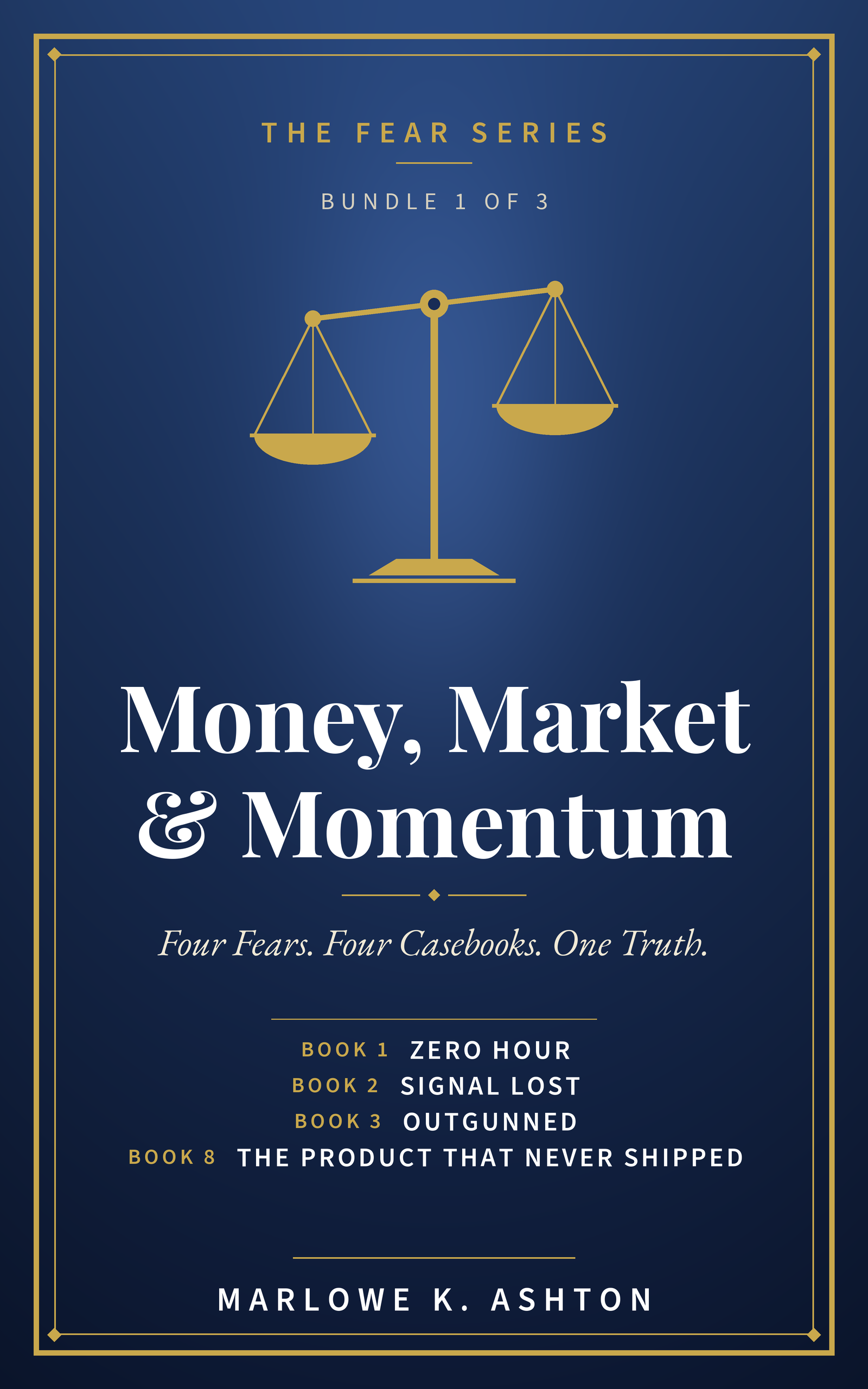
This bundle gathers four of the twelve practitioner casebooks in The Fear Series, each examining one of the fears that most commonly prevent technology entrepreneurs from making the decisions that would save their companies. The four collected here concern cash, customers, competitors, and the discipline of actually finishing what you start.
The series is built on a single premise: the fear is not the most dangerous thing. The decision the fear prevents is. The companies in these casebooks did not succeed because their founders felt less fear than others. They succeeded because they made better decisions despite feeling the same fear.
Every entrepreneur, at some point in the life of their company, stares at a spreadsheet that tells them the same thing: the money ends on a specific date. Not a vague, someday-we-might-struggle date. A specific Tuesday in a specific month, after which payroll does not clear, the office goes dark, and the company ceases to exist.
This is the master fear. Every other fear a technology entrepreneur carries — missing product-market fit, losing a key hire, facing a better-funded competitor, getting regulatorily shut down, suffering a public reputation collapse — ultimately leads here. All roads, if left untraveled long enough, end at cash zero.
This casebook is not about the fear itself. It is about the decision the fear prevents. Seven companies in this book came within weeks or days of running out of money. None of them did. What separates their survival from the hundreds of companies that did not survive is not luck, not a better product, and not a more sympathetic investor. It is a decision — made at the worst possible moment, under the worst possible pressure — that changed the trajectory of everything that followed.
The People Risk Nobody Plans For
Technology companies are, in the end, people companies. The code does not write itself. The customers do not trust themselves. The product decisions do not make themselves. Every line of competitive advantage in a technology startup traces back to a person — or a small group of people — who made a decision at the right time.
The fear of losing those people — a co-founder, a CTO, a head of sales, a critical engineer — is one of the most paralyzing fears in entrepreneurship because it is simultaneously the most likely and the least planned-for. Business plans have financial contingencies. They rarely have people contingencies.
This casebook documents seven technology companies that lost key people — co-founders, executives, or critical knowledge holders — and survived. The pattern is consistent: the companies that survived did not replace the person. They restructured around the absence.
The Fear That Controls All the Others
There is a fear more powerful than running out of money. More paralyzing than missing product-market fit. More consuming than being outgunned by a competitor with unlimited capital. It is the fear of everyone knowing you failed.
This is the fear that prevents the pivot that would save the company, because the pivot would require admitting that the original direction was wrong. It is the fear that delays the conversation with the investor about the cash position, because having that conversation would mean the investor knows there is a problem. It is the fear that keeps the founder raising money for a company they privately believe is not going to make it, because stopping would mean people would see.
The last fear is not about failure. It is about being seen to fail. And it is the fear that, more than any other, determines whether the other fears — of cash, of product, of competition, of regulation, of reputation — are navigated or avoided until they are fatal.
An acquisition that falls apart rarely fails for the reason either side expected to worry about at signing. Valuation gets negotiated hard and in the open; it is the thing everyone is watching. The deals in this book collapsed, or survived only in damaged form, because of something that was not being watched: a metric nobody had reconciled against raw data, a contractor agreement nobody had chased down, a regulator looking at an old structure with new eyes, a founder who had agreed to a price without agreeing, emotionally, to what came with it.
The eleven cases here span company stages and acquirer types -- strategic buyers, private equity, acqui-hires, competitive processes -- because the pattern is not specific to any one kind of deal. What is common across all of them is a gap between what the deal team believed had been settled and what turned out to still be open, discovered at the point in the process with the least time and the least leverage to fix it.
Four casebooks on winning the market — and the rules, pivots and platforms that decide who gets there.
Overview
A better product rarely wins on its own. The product that reaches the most people at the lowest cost does. The Growth & Distribution Bundle pairs the channel playbook with three disciplines that shape growth: knowing when to change course, working with (or against) the regulator, and building on AI without handing over control of your company.
Each book is a set of real-company case studies with the same readable structure, so you can read straight through or jump to the case that matches the decision in front of you.
What’s inside
· Distribution Moats — how startups win the channel war: built-in viral engines, Asian distribution masters, community builders and the distribution operating system.
· Post-Pivot Playbook — how founders change course without breaking the company. Almost no great company is doing what it set out to do.
· The Regulatory Playbook — how founders navigate, survive and shape the rules: confrontation, collision, compliance as a moat, and leverage.
· The AI Founder’s Dilemma — building with intelligence without losing control: foundation builders, the application-layer dilemma, vertical plays, and margin, trust and control.
Twelve Cases from America and Asia on Turning Less Money Into More Company — and Surviving What Others Don’t
“The question is never how much you raised. It is how much company you built per dollar — and how long you can keep building when the money stops.”
For the founders who learned that runway is a strategy, not an accident.
Burnout is one of the most consequential and least honestly discussed forces in the startup world. The cultural narrative has long celebrated the founder who sleeps in the office, skips weekends, and treats exhaustion as proof of commitment. That narrative has produced extraordinary companies—and extraordinary human damage.
This book does not tell you that ambition is wrong. It does not ask you to slow down, lower your expectations, or work fewer hours. It asks something harder: that you build systems capable of sustaining the pace you've chosen.
Every chapter in this book is a case study, and every case study follows the same shape. You will always know where you are.
Each one opens with a meta strip — the company, the era, the regulatory arena it entered, and the outcome — so you can orient in five seconds. Then comes a short lead that frames the central tension. “The Setup” gives you the conditions the founders faced. “What Happened” walks through the decisions and their consequences. A comparison table distills the mechanics. “The Regulatory Lens” pulls the strategic principle out of the story. And every case closes with five lessons you can act on Monday morning.
The companies span two worlds deliberately. You will read about Silicon Valley disruptors and Chinese super-apps, European fintechs and Indian payments giants, because regulation is the one discipline where geography changes everything. A founder navigating the RBI in Mumbai faces a different referee than one facing the SEC in Washington or the PRA in London — and the contrasts are where the lessons live.
In more than five hundred business plan reviews, I have never seen a startup die from a lack of ideas. I have watched dozens die from talent decisions: the co-founder split nobody papered, the executive hired two stages too early, the toxic star whose revenue everyone was afraid to lose, the layoff done in three flinching rounds instead of one honest cut.
Talent strategy is the least-taught discipline in company building. Fundraising has an industry of advice. Product has a literature. But the decisions that actually compound — who you hire first, how equity vests, when loyalty must yield to honesty, how you let people go — are mostly learned by expensive experience, one founder at a time.
This casebook is that experience, compressed. Each of the twelve cases that follow is drawn from patterns I have seen repeatedly across four decades in early-stage technology — composites, with details altered, but with the decisions and their consequences intact. Each case follows the same structure: the Situation a founder faced, the Action taken, the Result that followed, a comparison table you can apply to your own circumstance, and five founder lessons stated plainly enough to act on.
Read them in any order. Better still, read the one you are currently avoiding.
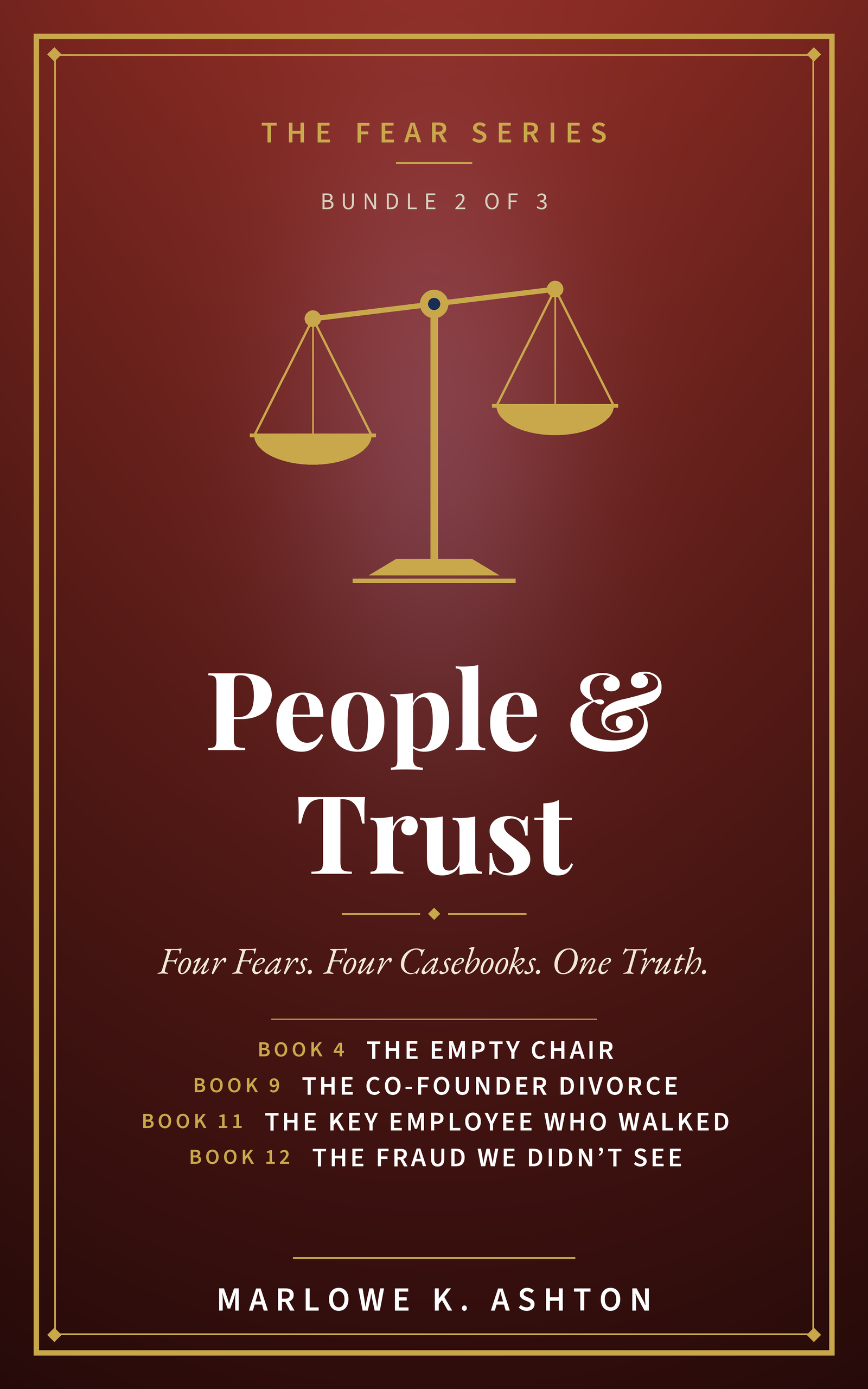
This bundle gathers four of the twelve practitioner casebooks in The Fear Series, each examining one of the fears that most commonly prevent technology entrepreneurs from making the decisions that would save their companies. The four collected here concern the people a company depends on: key hires, co-founders, the employee who walks, and the betrayal nobody saw coming.
The series is built on a single premise: the fear is not the most dangerous thing. The decision the fear prevents is. The companies in these casebooks did not succeed because their founders felt less fear than others. They succeeded because they made better decisions despite feeling the same fear.
The Empty Chair - Losing key people
The Co-Founder Divorce - Losing a co-founder
The Key Employee Who Walked - Losing the person the company depends on
The Fraud We Didn't See - Betrayal from within
There is a specific kind of company death that does not announce itself. The product ships. The press release goes out. The team celebrates. Users arrive — and then, slowly and then suddenly, they stop. No one unsubscribes dramatically. No one writes a scathing review. They simply do not come back. Downloads accumulate. Active users do not.
This is the invisible wall of missing product-market fit. Unlike running out of money — which has a date — missing product-market fit has no announcement. It reveals itself in retention curves, in support tickets that reveal confusion rather than enthusiasm, in the gap between the product the team is proud of and the product customers would pay to keep.
This casebook documents seven technology companies that hit the invisible wall and found their way through it. None of them found product-market fit by building more features. They found it by changing what question they were answering.
The Letter Nobody Wants
There is a specific kind of morning that every founder who has navigated regulatory risk remembers precisely: the morning the letter arrived. The cease-and-desist. The subpoena. The notice of investigation. The regulatory inquiry that begins, in carefully formal language, to describe the difference between what your company does and what the law permits.
This fear is different from the fear of running out of money or missing product-market fit. Regulatory risk has an adversary with institutional power, legal authority, and patience. It cannot be pivoted around or outworked. It must be navigated — and the navigation requires a different set of skills than building products or finding customers.
The companies in this casebook have all faced existential regulatory risk. None of them were shut down. The common thread is not that they had better lawyers. It is that they had a strategy — a theory of how to engage with regulators, legislators, and the public — before the crisis arrived.
Scope creep rarely looks like failure while it's happening. It looks like diligence. It looks like a team taking a customer request seriously, or an engineer insisting on getting the architecture right, or a founder refusing to ship something half-finished. Every individual decision in this book was defensible in the room where it was made. That is what makes the pattern dangerous, and what makes it worth eleven case studies instead of one.
The eleven companies in this volume did not fail because they built the wrong thing. They failed because they never stopped building, past the point where stopping and shipping would have told them whether the thing was right. Some never launched at all. Others launched so late that the market had already answered the question without them. A few shipped something excellent, on a timeline that made the excellence irrelevant.
Each case follows the same structure used throughout the Fear Series: Situation, Action, Result, Lessons, and a Before AI / After AI comparison showing where a different information flow -- not a different level of talent or effort -- might have surfaced the drift while there was still time to correct it. The pattern across all eleven is not a shortage of intelligence or good intentions. It is a shortage of a mechanism, independent of the people closest to the work, that would have made the drift visible before it became the whole story.
A key employee rarely leaves without warning. The warning is usually there months in advance -- in a comment made once and never repeated, in declining engagement on a project only their direct reports notice, in an exit interview from someone else on the same team that names the exact problem that will resurface later. What these eleven companies share is not a shortage of signal. It is a shortage of a mechanism that routes the signal to someone with the standing and the mandate to act on it before the resignation letter arrives.
The cost of a key departure is rarely just the search-and-replace cost of hiring someone new. It is the relationships that left with them, the undocumented knowledge that walked out the door, the team members who read the departure as permission to leave too, and the momentum lost while the organization relearns what one person already knew. Several of the cases in this book show that cost compounding for months after the actual resignation.